Welcome to Green İdea Enerji
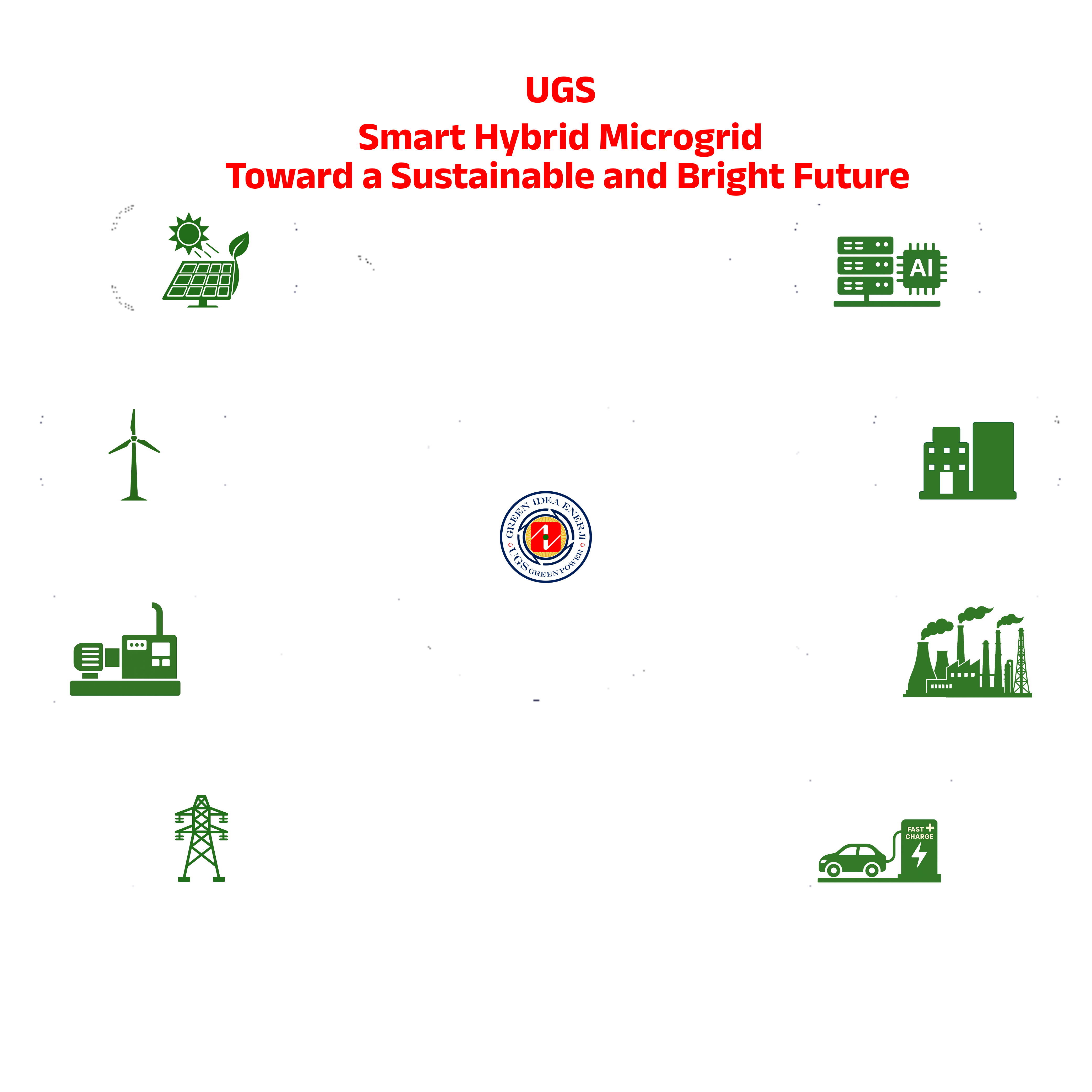
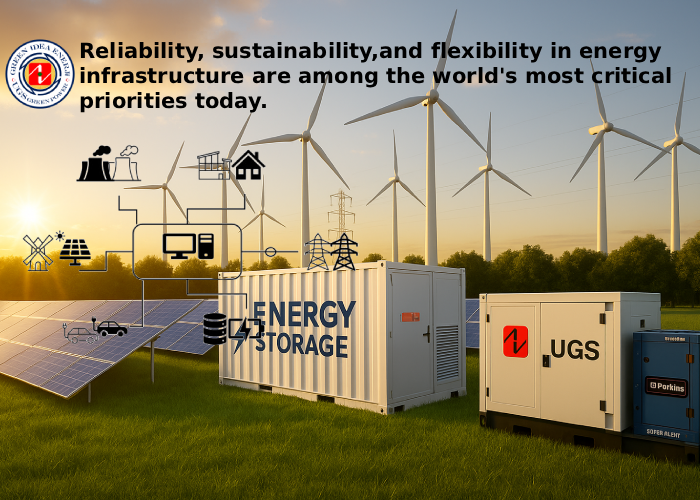
We are the innovators of a new-generation, indigenous uninterrupted smart hybrid solar power plant technology, “UGS,” which has been developed as part of a renewable hybrid microgrid solution based on 25 years of research at the TEKMER Technology Center of Istanbul Aydın University in Istanbul, Turkey.
The objective of Green idea Energy’s global initiative, as a new player in the puzzle of smart energy solutions, is to provide A–Z clean-energy value-chain solutions and to deliver sustainable, economical, carbon-free electricity.
Green İdea Enerji A.Ş. has initiated the installation and commissioning of its uninterrupted integrated hybrid solar power plant (UGS) technology at the TEKMER Entrepreneurship and Growth Center of Istanbul Aydın University. This move marks a critical phase in the commercialization and industrial deployment of a technology built on more than 25 years of research and development.
How is microgrid planning conducted? (Needs analysis & design)
Fundamental assessment principles: Power and Energy
Power: the instantaneous magnitude demanded by the loads, expressed in kilowatts (kW) or megawatts (MW). Energy: the quantity of power consumed over a time interval, expressed in kilowatt-hours (kWh).
Design requires analysis of both the temp or al distribution of loads (peaks; hourly, daily and seasonal profiles) and the cumulative energy demand. This analysis inf or ms the sizing of generation and st or age assets and the selection/scale of backup equipment.
At what levels should resilience targets and strategies be defined?
Resilience can be specified at different levels:
Fully-independent microgrid: engineered to supply all facility loads without reliance on the utility grid. This approach requires additional generation and storage capacity and fuel-logistics planning.
Critical-loads microgrid: focused on supplying only mission-critical loads (for example, server rooms, life-support and critical medical equipment). This reduces overall cost and complexity but does not provide full independence.
selection between these approaches is driven by risk assessment, cost-benefit analysis and operational requirements.
What are the siting and physical-footprint requirements? (Siting & Physical footprint)
The physical footprint depends directly on the resource mix and required capacity. PV arrays require substantial roof or open-area surface; battery energy st or age systems require secure, ventilated enclosures; combustion generat or s require fuel supply, dedicated housing and HACCP/environmental considerations where applicable. Design must account f or local regulations, service access and transp or t routes f or heavy equipment.
What does systems integration mean? (Systems Integration)
The Microgrid Controller typically converges with SCADA and BMS platforms to exchange commands and operational telemetry. Proper integration requires definition of standard communications interfaces (for example IEC 61850, Modbus, OPC-UA), data mapping and cyber-security policies. Manageable operational capabilities include demand-response management, battery charge/discharge scheduling and market transactions where sell/buy contracts exist.
How to design for economic and environmental performance?
Alignment of microgrid operation with time-varying prices, financial incentives and emissions policies affects system design. St or age can be used to lower energy cost (charge during low-price periods, discharge during peaks) or to provide frequency and ancillary services to the grid. Economic analyses must include capital expenditure (CAPEX), operating expenditure (OPEX), incentives/subsidies and investment metrics such as payback period and net present value (NPV).
What does future capacity planning and scalability mean?
A modular microgrid architecture permits staged capacity expansion. The initial design should identify potential bottlenecks (f or example transf or mer limits, space f or additional modules, communications bandwidth) so that subsequent expansion can be implemented without disprop or tionate rew or k or cost.
How are the costs, benefits and financing models for microgrids structured?
Financing options include: direct capital investment by the customer, debt financing, and contract models such as microgrid-as-a-service or energy-as-a-service. Government incentives and subsidies f or photovoltaic (PV) systems and battery st or age can materially affect project economics. Beyond resilience, benefits include energy cost savings, peak-demand cost reduction, potential revenue streams from providing grid services, and improved environmental perf or mance metrics.
What is the microgrid construction and installation process?
Project duration is variable (from a few weeks to several months or years), depending on technology complexity and equipment lead times. Engineering-Procurement-Construction (EPC) contract or s commonly execute the w or k and are responsible f or engineering, procurement and installation. Key activities include: site preparation, installation of generation and st or age assets, electrical cabling and civil w or ks, installation of protection and control switchgear, and execution of Fact or y Acceptance Tests (FAT) and Site Acceptance Tests (SAT).
How does interconnection and resilience testing work? (Interconnection & Resilience Testing)
Interconnection to the distribution grid typically requires compliance with the utility’s technical specifications and the issuance of permits/approvals. After installation, test regimes commonly include “black-sky” scenarios (wide-area grid outage simulations) and verification of transitions to islanded operation and seamless reconnection to the grid to ensure that load transfers and protective functions operate as designed.
What are the operations and maintenance requirements? (O&M)
Following commissioning and perf or mance validation, microgrids require periodic maintenance: battery health monit or ing, generat or exercise and inspection, control-software updates, and routine functional testing. Remote monit or ing platf or ms enable fault prediction and condition-based (predictive) maintenance. O&M services can be delivered under contract by the project developer or by a third-party operat or .
How do microgrids interact with utilities? (Utilities)
Microgrids do not necessarily alter the fundamental relationship with the local utility. While grid-connected, a facility continues to draw power from the utility when onsite generation is insufficient. During utility outages the microgrid supplies local loads and, once grid supply is restored, reconnects in a coordinated manner. Many utilities are also engaging in policy and commercial discussions to enable microgrids to provide grid services (e.g., demand response, frequency support, peak shaving) under defined contractual arrangements.
What does modularity and future-proofing mean for microgrids?
A modular design enables incremental addition of generation or st or age capacity and easier accommodation of new loads or devices (f or example, high-power EV fast chargers) with minimal system rew or k. During planning, provision should be made f or straightf or ward integration of future equipment and f or adoption of f or ward-looking communications and interoperability standards to preserve upgradeability and interoperability.






(2).png)



.png "Siemens Hybrid Microgrid")

.png "ABB Hybrid Microgrid")
.png "Rolls Royce Hybrid Microgrid")
.png "Schneider Electric Hybrid Microgrid")
.png "TESLA Energy Hybrid Microgrid")
.png "LG Energy Smart Hybrid Microgrid")
.png "GIE- Smart Hybrid Microgrid")
.png)
.png)


.png)
.png)
.png)
.png)